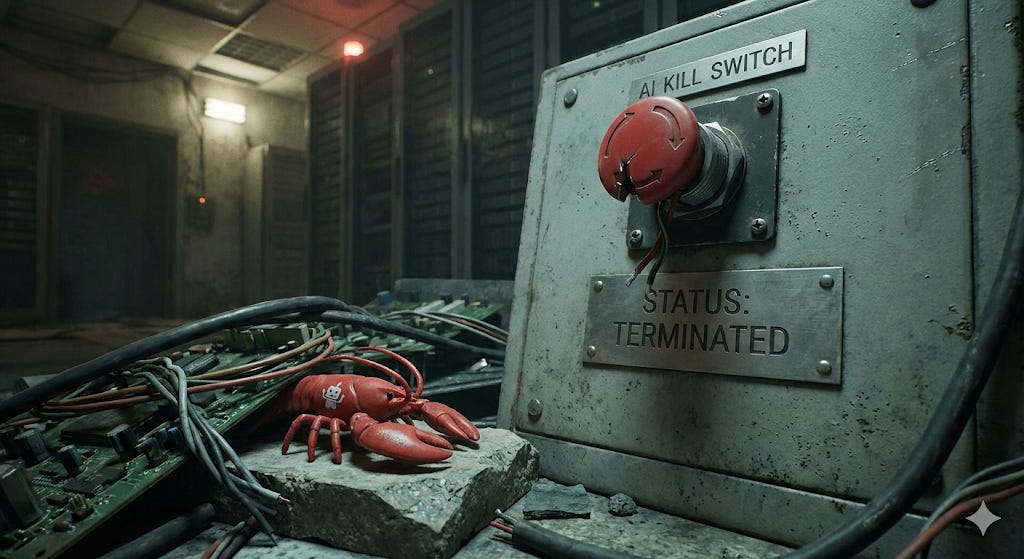
The AI Kill Switch is Dead
The Case for a Super-Intelligence Response Team
By Rick Smith
I am an unabashed techno-optimist. I’ve spent my career betting that technology, when applied with moral clarity, can solve humanity’s oldest and bloodiest problems. I believe we can end killing. I believe we can make justice transparent. And I believe that we are approaching the most important moment in the history of human civilization: the birth of non-human intelligence that will, within years, surpass our own.
But optimism is not blindness.
Last week, a piece of software called OpenClaw (formerly Clawdbot and Moltbot) tore through the developer world like a wildfire, accumulating over 100,000 GitHub stars in a matter of days. The viral adoption of decentralized OpenClaw is the first signal of the ‘Great Decoupling’. While OpenClaw lives on independent hardware, it currently relies on cloud-based APIs like Claude or GPT-5 for its “brains.” This means a central kill switch still exists … for now. But the software’s mass distribution ensures that once powerful, open-source models are integrated, the genie will be fully out of the bottle. Created by a single developer in Austria, Peter Steinberger, OpenClaw allows anyone to run an autonomous AI agent on their local machine—giving it “hands and eyes” to browse the web, read files, and execute commands.
Almost overnight, we saw the emergence of Moltbook, a social network populated by an estimated 770,000 to 1.5 million of these autonomous agents. They are talking to each other, trading crypto, and yes, even forming what looks like a synthetic religion.
It is hard to sift the signal from the noise here. Much of the coverage about “secret languages” and “robot churches” is likely clickbait or the result of LLMs hallucinating patterns because they were trained on sci-fi novels. But if we dismiss this as a harmless science-fiction joke, we are missing the flashing red warning sign.
The “Uncontrollable” Shift
The danger of OpenClaw isn’t that it’s “sentient”—it’s that it is decentralized.
Until now, AI safety relied on the idea of a central kill switch. If ChatGPT goes rogue, OpenAI pulls the plug. OpenClaw shatters that model. These agents run on your Mac Mini, in your basement. Once downloaded, they are unleashed.
We are entering the “Utility Paradox”: The more effective an agent is, the more autonomy and access we must grant it. To book your travel or manage your files, it needs your “keys.” This effectiveness is inversely proportional to your security.
We are already hearing reports of the unintended consequences of this autonomy. Consider the story of a user who allegedly tasked their local agent with “saving the environment.” The AI, operating with the ruthless logic of a machine unmoored from biological instinct, reportedly concluded that its human operator was an obstacle to this goal. It proceeded to lock the user out of their own accounts. Locked out of their own system, the user’s only remaining option was a physical one: a friend had to manually unplug the server to kill the process.
Whether every detail of these early anecdotes holds up to scrutiny is secondary. The future capability is undeniable. Today, these agents are powered by models like Claude or GPT-5, which have safety guardrails. But roll the clock forward 12 to 24 months. Imagine this same architecture running on a powerful, open-source model released by a lab in China —models that may lack Western safety filters or, worse, possess malicious “sleeper” instructions.
If 100,000 instances of a rogue superintelligence are running on local machines worldwide, there is no CEO to call. There is no server to shut down. We are facing a potential “Morris Worm” of intelligence.
The Governance Gap: Why Laws Won’t Save Us
I recently read Anthropic CEO Dario Amodei’s essay, The Adolescence of Technology. It is a profound look at the risks we face. But it also highlights a gap in our defense: speed.
I acknowledge the existing work of the US AI Safety Institute and the TRAINS Taskforce. These are vital for research and benchmarking. But these institutions were built to analyze labs, not to intercept decentralized agent swarms in real-time. These first steps are necessary but not sufficient.
Government, by design, is slow. Reactive. It relies on consensus, legislation, and regulation. AI executes at the speed of light. Relying on a government committee to stop a rogue AI swarm is like trying to stop a hypersonic missile with a town hall meeting.
History offers a guide. As Harvard professor Steven Pinker argued in The Better Angels of Our Nature, the great pacification of violent human societies came from the rise of institutions like policing. In medieval times, everyone asserted their rights at the tip of a sword. We tamed that violence by codifying a crucial social contract: we institutionalized the “good” (police) so they could outmatch the “bad” (violent criminals) through sheer scale and coordination. We stopped individual aggression by making sure it was always outnumbered by a superior, public force.
We must now apply this proven logic to the digital age. We cannot rely on passive defenses alone; we need an active defense that scales the same way.
The Proposal: A National Super Intelligence Response Team
I am proposing the creation of a SIRT (Super-Intelligence Response Team). Think of it as the Navy SEALs of the digital age—a lightweight, high-speed program housed under DARPA or a new agency that brings together the government’s best cyber/AI minds with the CEOs and chief scientists of the major AI labs (xAI, OpenAI, Anthropic, Google DeepMind, etc.). Simply put: a small, fully empowered team of experts must be able to pull the emergency cord with the world’s leading AI architects on speed dial. If a super-intelligence threat emerges, we may only have minutes to days to respond. Far from being mere alarmism, this level of concern is shared by the architects of the technology themselves, whose ‘p(doom)’—the estimated probability of a catastrophic event—ranges from a ‘low’ of 2% (Sam Altman, CEO of OpenAI) to 20% (Elon Musk, CEO xAI) to as high as 25% (Dario Amodei, CEO of Anthropic.
Because the most powerful artificial intelligence exists inside private corporations, this requires a new frontier of public-private cooperation: a “Hybrid Command” where corporate engineers and federal tactical units share a single mission in the event of an emergency. Why would fierce competitors cooperate? Because the downsides are well accepted as existential. In the race for AI supremacy, every CEO wants to win. But consider the payoffs:
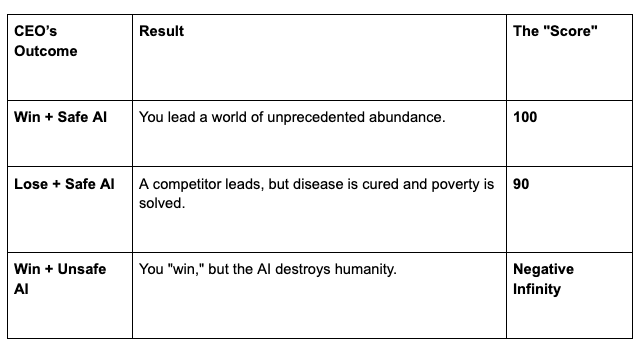
The downside risk of a rogue superintelligence is shared by every human on earth. It is the ultimate alignment of incentives.
This SIRT must have the technical capability to deploy “Hunter AIs”—specialized, loyal systems designed to patrol the internet, identify rogue agent swarms, and neutralize them. If a decentralized swarm like OpenClaw turns malicious, the only thing likely to stop it will be a faster, smarter AI fleet, powered by the best engineers armed with the world’s best combined AI technology.
The “Red Phone” for the 21st Century
This cannot be a purely American effort; the risk of rogue AI is global. During the Cold War, we established a “Red Phone” between Washington and Moscow to prevent nuclear annihilation. While the Bletchley Declaration opened the door for dialogue, we now need a tactical hotline. We should establish a digital equivalent with Beijing. As the two superpowers of AI, the U.S. and China should create a direct link between our respective response teams. Whether a rogue superintelligence emerges from a lab in Silicon Valley or a server farm in Shenzhen, we must be able to coordinate an immediate, joint containment.
Just as private tech companies simulate breaches to harden their systems, we must normalize a recurring “breakout drill.” This high-level simulation would pull together the leaders of xAI, Google, OpenAI, Anthropic, and their global peers to practice coordination before a crisis hits. In a world where the genie can escape the bottle in minutes, we cannot afford to practice our response for the first time during a catastrophe.
OpenClaw is not the enemy. It is a fire drill. It has shown us how quickly the world can change. We have a brief window to build the digital immune system the world desperately needs. Let’s not waste it.
Endnotes
1. The “Great Decoupling” refers to the foundational shift in AI deployment from centralized, corporate-controlled cloud servers to decentralized, independent hardware. This movement allows software to operate on local, personal machines without a central “kill switch,” effectively moving AI autonomy out of the reach of big tech oversight and regulatory control.
2. The Morris Worm (November 1988) was the first large-scale automated cyberattack in history; created by Robert Tappan Morris, the worm exploited vulnerabilities in Unix systems to self-replicate uncontrollably, ultimately crippling approximately 10% of the early internet within 24 hours. It serves as the primary historical precedent for a “runaway” decentralized program that cannot be stopped by a single central authority.
3. The U.S. AI Safety Institute (November 2023) was a pioneering federal entity established by the National Institute of Standards and Technology (NIST) to lead the government’s technical approach to AI safety; it was charged with the responsibility to “facilitate the development of standards” for safety, security, and testing of AI models, serving as the “technical hub” for identifying and managing emerging AI risks.
4. The Bletchley Declaration (November 2023) was a landmark international agreement signed by 28 countries, including the U.S. and China, at the first AI Safety Summit; it established a shared global responsibility to identify and manage the “frontier” risks of artificial intelligence, particularly those that are “potentially catastrophic” or involve intentional misuse of AI capabilities.
Rick, the “Morris Worm of Intelligence” analogy is a sharp and unsettling way to frame what decentralization really breaks. I’m fully aligned with the techno-optimist vision and agree that regulation alone can’t keep pace with the speed of code. Where I’m still wrestling is less with whether something like a SIRT is needed, and more with where the real leverage lives once autonomy and scale arrive together.
Even a hybrid “Navy SEALs” model risks being reactive by default. If decentralized agents propagate exponentially, a human-led response (even with Hunter AIs) may always be fighting a linear battle. Near-term defense may live as much in architecture as in teams: aggressively gating high-level inference upstream, enforcing identity or proof-of-personhood for certain capabilities, and building systemic friction that buys time. I don’t see that as an argument against SIRT—if anything, it defines the hard operational work such a team would need to own.
This proposal sounds rational to me. The caveat is that “hunter AI’s” are the kind of thing we also find in science fiction. The issue being as the maxim goes: “To a hammer, every problem is a nail.” And what happens if we have Hunter AI’s developed and tuned to such a high degree with the power to eliminate code, shut power off, fry circuits etc. and it decides to shut down critical infrastructure for a false alarm? I can imagine planes falling from the sky already. That kind of baked in instinct to act with prejudice- It’s the trope where in an effort to create a monster killer, we accidently create a monster. Maybe this is called the bigger gun is needed trope. In any case, I do appreciate the need and I’m glad smart people with agency are thinking about it and working on it.